October 30, 2025
Written by
No items found.

Qurious Minds: Meet Cameron Lauvitel

Qurious Minds: Meet Cameron Lauvitel

Qurious to know what it’s like to work in a field where a new job often comes with a new country? Cameron Lauvitel joined SemiQon as Lead of Quantum Processor Design in the summer of 2025, moving to Espoo after previously living and working in the UK, Switzerland and France.

Finding quantum

Cameron always knew he wanted to do science, though his path into quantum was not entirely straightforward.

“I always knew I wanted to do science, but when I finished high school, I actually didn’t get straight into university,” he says. “When I went to the University of York to do Physics, I started out studying astrophysics. However, when I started the courses on quantum mechanics, I was hooked.”

As he explored the field further, he came across the idea of quantum computing, which at the time was still fairly niche.

“I looked into the field more and discovered the idea of quantum computing and thought, "Okay, this is what I want to do."

Cameron completed his doctorate at Institut Néel in Grenoble and entered the quantum field at a time when it was only beginning to take shape. Since then, he has worked both at a quantum startup, Riverlane, and in an established HPC firm on their quantum agenda.

Working across borders

Cameron’s work in quantum has taken him from one country to another. “Quantum truly is an international job market, and the best professional fit often means being open to different geographical areas,” he says.

He points out that working in quantum to some extent requires planning life around work and being transparent about expectations.

“At SemiQon, I’ve started working onsite with the team in Espoo, but I also have flexibility about how to organize my work, which allows more time with family.”

A role at SemiQon

At SemiQon, Cameron took on a more senior role, which he finds motivating.

“It can be intimidating, of course, but I prefer having more responsibility and pressure rather than being a part of a larger team where there really isn’t that much riding on you, but also, you don’t make that much of an impact.” he says.

In his role, Cameron works closely with IC designers. While they focus on the circuitry, his responsibility is the qubits.

“I’m essentially designing a motherboard for a quantum computer,” he explains. “I design the qubits. I am developing the quantum dot structures and the technology we need to control, entangle and read out our qubits. Alongside that, I’m also planning for the future: How do we scale our architecture? What do we do when and how long is it going to take? It’s definitely a challenge, but really interesting.” he says.

What makes Cameron confident in SemiQon’s ambitions is that the company is not just doing quantum. “With cryo-CMOS, we also have near-term applications for our technology,” he says.

He points to the strong fundamentals already in place. “Our low-power transistor is a solid building block for our cryo-CMOS circuitry,” he highlights.

Cameron also highlights that SemiQon’s work is designed for industry. “Our spin qubits are fabricated using an industrially compatible FDSOI process at the Micronova facility, where the team can also leverage flexibility to experiment.”

Quantum and its potential

What draws Cameron to quantum is the amount that is still unknown.

“The most exciting thing for me is the unknown,” he says. “In many fields you have to go really deep before encountering something new, but with quantum there is so much we don’t know.”

He compares the current moment in quantum to the early days of personal computing.

“Just think about the paradigm shift that happened with personal computers and the sheer amount of opportunities and ideas that it opened,” he says. “We will probably only find the real extent of what quantum computers can do when we have something to experiment on and play around with.”

At the same time, Cameron is cautious about hype.

“I think one of the perceptions that can be damaging is the hype and empty promises that form around emergent fields like quantum,” he says. “What we do is already exciting. We don’t need to overpromise.”

“The most exciting thing for me is the unknown,”
Cameron kayaking with a colleague, Janne Ikonen.

Learning, balance and support

Professionally, Cameron looks for environments where he can keep learning.

“I’m always looking for something that’s going to make me learn something new,” he says. “I wouldn’t go to a company full of Camerons. I value diversity of opinions and think disagreement is what makes you grow.”

Outside of work, he spends time outdoors, especially in the mountains. He enjoys hiking, climbing and skiing, and also plays music and writes fiction.

Reflecting on his experience at SemiQon, Cameron highlights the sense of support within the team.

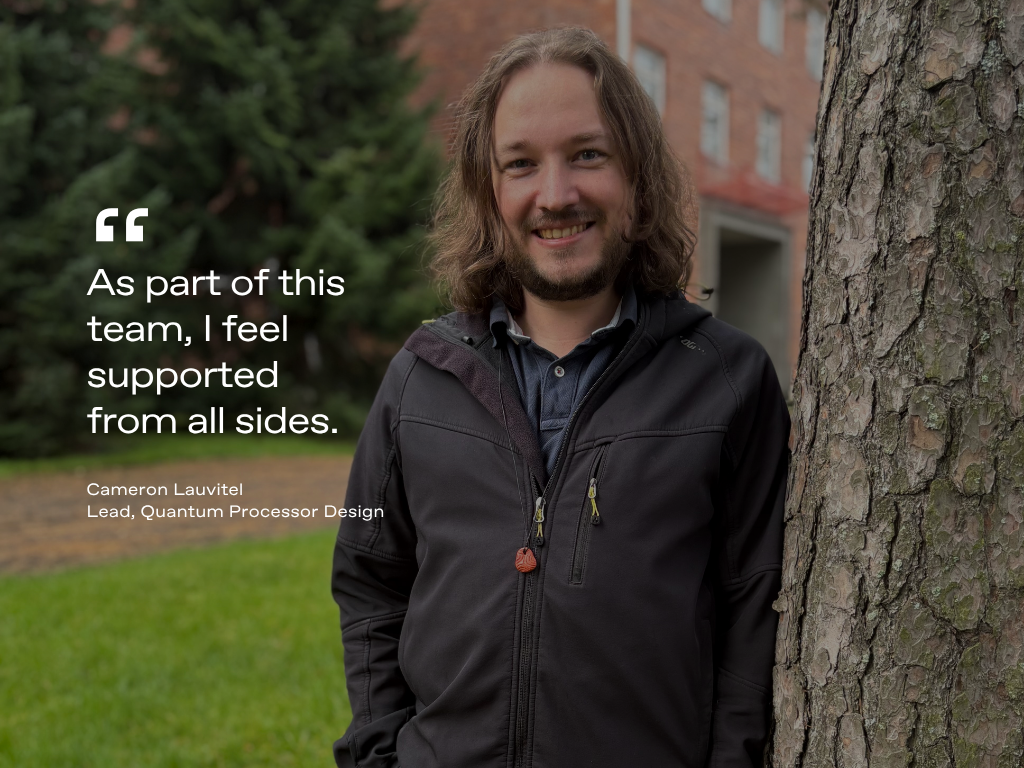
“As part of this team, I feel supported from all sides,” he says.
Qurious to join a team of Qurious minds? Information about our open positions and how to apply is available on our careers page.

October 30, 2025

Qurious Minds: Meet Cameron Lauvitel

Qurious Minds: Meet Cameron Lauvitel

Qurious to know what it’s like to work in a field where a new job often comes with a new country? Cameron Lauvitel joined SemiQon as Lead of Quantum Processor Design in the summer of 2025, moving to Espoo after previously living and working in the UK, Switzerland and France.

Finding quantum

Cameron always knew he wanted to do science, though his path into quantum was not entirely straightforward.

“I always knew I wanted to do science, but when I finished high school, I actually didn’t get straight into university,” he says. “When I went to the University of York to do Physics, I started out studying astrophysics. However, when I started the courses on quantum mechanics, I was hooked.”

As he explored the field further, he came across the idea of quantum computing, which at the time was still fairly niche.

“I looked into the field more and discovered the idea of quantum computing and thought, "Okay, this is what I want to do."

Cameron completed his doctorate at Institut Néel in Grenoble and entered the quantum field at a time when it was only beginning to take shape. Since then, he has worked both at a quantum startup, Riverlane, and in an established HPC firm on their quantum agenda.

Working across borders

Cameron’s work in quantum has taken him from one country to another. “Quantum truly is an international job market, and the best professional fit often means being open to different geographical areas,” he says.

He points out that working in quantum to some extent requires planning life around work and being transparent about expectations.

“At SemiQon, I’ve started working onsite with the team in Espoo, but I also have flexibility about how to organize my work, which allows more time with family.”

A role at SemiQon

At SemiQon, Cameron took on a more senior role, which he finds motivating.

“It can be intimidating, of course, but I prefer having more responsibility and pressure rather than being a part of a larger team where there really isn’t that much riding on you, but also, you don’t make that much of an impact.” he says.

In his role, Cameron works closely with IC designers. While they focus on the circuitry, his responsibility is the qubits.

“I’m essentially designing a motherboard for a quantum computer,” he explains. “I design the qubits. I am developing the quantum dot structures and the technology we need to control, entangle and read out our qubits. Alongside that, I’m also planning for the future: How do we scale our architecture? What do we do when and how long is it going to take? It’s definitely a challenge, but really interesting.” he says.

What makes Cameron confident in SemiQon’s ambitions is that the company is not just doing quantum. “With cryo-CMOS, we also have near-term applications for our technology,” he says.

He points to the strong fundamentals already in place. “Our low-power transistor is a solid building block for our cryo-CMOS circuitry,” he highlights.

Cameron also highlights that SemiQon’s work is designed for industry. “Our spin qubits are fabricated using an industrially compatible FDSOI process at the Micronova facility, where the team can also leverage flexibility to experiment.”

Quantum and its potential

What draws Cameron to quantum is the amount that is still unknown.

“The most exciting thing for me is the unknown,” he says. “In many fields you have to go really deep before encountering something new, but with quantum there is so much we don’t know.”

He compares the current moment in quantum to the early days of personal computing.

“Just think about the paradigm shift that happened with personal computers and the sheer amount of opportunities and ideas that it opened,” he says. “We will probably only find the real extent of what quantum computers can do when we have something to experiment on and play around with.”

At the same time, Cameron is cautious about hype.

“I think one of the perceptions that can be damaging is the hype and empty promises that form around emergent fields like quantum,” he says. “What we do is already exciting. We don’t need to overpromise.”

“The most exciting thing for me is the unknown,”
Cameron kayaking with a colleague, Janne Ikonen.

Learning, balance and support

Professionally, Cameron looks for environments where he can keep learning.

“I’m always looking for something that’s going to make me learn something new,” he says. “I wouldn’t go to a company full of Camerons. I value diversity of opinions and think disagreement is what makes you grow.”

Outside of work, he spends time outdoors, especially in the mountains. He enjoys hiking, climbing and skiing, and also plays music and writes fiction.

Reflecting on his experience at SemiQon, Cameron highlights the sense of support within the team.

“As part of this team, I feel supported from all sides,” he says.

Qurious to join a team of Qurious minds? Information about our open positions and how to apply is available on our careers page.